Axel Adler Scholarship 2027: Tuition Waiver in Sweden
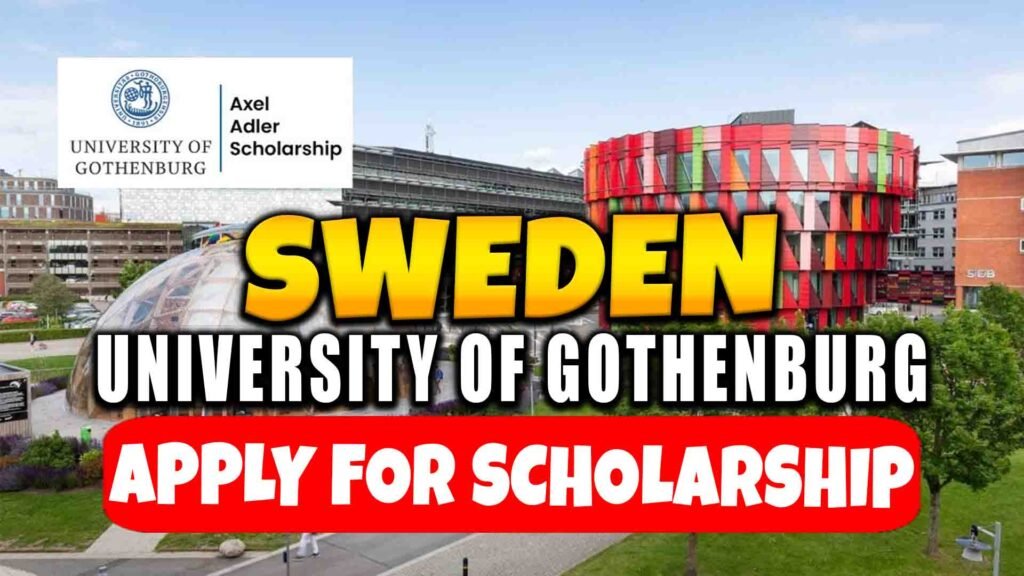
The Axel Adler Scholarship 2027 is a tuition fee waiver from the University of Gothenburg in Sweden. It is for international students who must pay tuition fees and who rank a Gothenburg campus programme as their first choice. The next deadline is 15 January 2027, when you must submit your application for studies on universityadmissions.se. The university awards one scholarship per master’s programme, plus a few extra awards if funds allow, so competition can be strong. The scholarship covers tuition only, not living costs.
Scholarship Summary
| Item | Details |
|---|---|
| University | University of Gothenburg |
| Country | Sweden |
| Degree level | Full-time, campus-based master’s programmes. Seven named bachelor’s programmes are also eligible. |
| Funding | Partially funded: tuition fee waiver for the whole programme. No living allowance. Scholarship holders are covered by FAS+ insurance. |
| Eligible nationalities | No country list. You must be required to pay tuition fees in Sweden. In general, this means citizens of countries outside the EU/EEA and Switzerland. |
| Deadlines (2027 round) | 15 January 2027: apply for your programme and rank Gothenburg first. 1 February 2027: pay the application fee and submit documents. 10 February to 8 March 2027: scholarship application window (invitation email). 12 April 2027: master’s results. Time zone not stated. |
| Intake | Autumn 2027 |
| Language requirement | English. Most master’s programmes ask for English 6 level (for example IELTS Academic 6.5, no section below 5.5). Check your programme page. |
| Official link | https://www.gu.se/en/study-in-gothenburg/apply/scholarships-for-fee-paying-students/axel-adler-scholarship |
Benefits and Funding
The scholarship is a tuition fee waiver. According to the official requirements, it covers the tuition fee for the whole programme you are admitted to. We call it partially funded because it has no living allowance.
What is covered
- Tuition for the full programme: four semesters (120 credits) for master’s programmes, with two semesters (60 credits) for one-year master’s programmes, and six semesters (180 credits) for the eligible bachelor’s programmes.
- FAS+ insurance. The requirements say scholarship holders are covered by FAS+, issued under the authority of the Swedish Legal, Financial and Administrative Service Agency (Kammarkollegiet). The terms are on that agency’s website.
- Payment to the university. The foundations pay the university directly, so you do not pay the waived amount yourself.
The funders are the Adlerbertska Scholarship Foundation, the Adlerbertska Grant Foundation and the Swedish Council for Higher Education (UHR).
There is also an Axel Adler Scholarship for Sustainability. It is an extra tuition waiver for students admitted to a sustainability-focused master’s programme, and between 2 and 12 students receive it.
What is not covered
- Living and accommodation costs.
- Flights, visa or permit fees, and the SEK 900 application fee are not listed as covered in the official requirements.
Tuition varies by programme. For example, the Master’s Programme in Global Health listed a full education cost of SEK 324,000 for the 2026 start. Check your own programme page for the 2027 figure.
Eligibility Criteria
Fee status. You must be required to pay tuition fees in Sweden. Swedish rules say universities charge tuition to people who are not citizens of an EEA country or Switzerland. Programme pages at the university say no fees are charged for EU/EEA citizens, Swedish residence permit holders and exchange students.
Programme and ranking. You must apply to an international campus-based programme and rank it first in the international admission round by 15 January 2027. If you apply to several Gothenburg programmes, only the first-ranked one is considered.
Admission. The award goes to students admitted to a full-time master’s programme, or to one of seven named bachelor’s programmes. The official FAQ indicates that online programmes are not eligible.
Academic. For master’s studies you need a bachelor’s degree equal to a Swedish kandidatexamen from an internationally recognised university. Many programmes also ask for credits in a specific subject. The university says selection is mainly based on your qualifications for the programme you applied to.
Language. English is always a specific entry requirement at master’s level. See the language section below for accepted tests.
Age and work experience. The official pages we checked set no age limit or work-experience rule for the scholarship. Some programmes may set their own. Not confirmed: check your programme page.
Who should not apply. This scholarship is not suited to you if you are exempt from tuition fees, if Gothenburg is not your first-ranked choice, or if your programme is online. It also does not help if you need money for living costs.
Required Documents
Your scholarship application has only two parts, and you write both inside the scholarship system. You cannot upload files to it.
- CV, written in the scholarship application system
- Letter of motivation, written in the same system
- If you apply for the sustainability scholarship: a separate motivation (up to 3,000 characters) about how you have focused, or plan to focus, your studies on sustainability
For your university application, you must submit documents showing you meet the entry requirements by 1 February 2027. The exact list depends on the country where you studied.
- Bachelor’s degree certificate and transcripts
- Proof of English, unless your studies already meet the requirement
- Payment of the SEK 900 application fee
- Any extra documents your programme asks for (for example, work samples for arts programmes)
Not confirmed: check the country instructions for your degree on universityadmissions.se.
How to Apply
- Pick an eligible programme. Choose a full-time, campus-based international programme. Read the programme page for tuition, entry requirements and dates. For example, the Master of Science in Management lists an application period of 16 October 2026 to 15 January 2027 and a start on 30 August 2027.
- Apply on universityadmissions.se. Create an account, apply, and rank your Gothenburg programme first by 15 January 2027. You can choose up to four programmes in the first round.
- Pay and document by 1 February 2027. Pay the non-refundable SEK 900 application fee and upload your documents at https://www.universityadmissions.se.
- Watch your email. Eligible applicants get scholarship instructions around 10 February 2027, at the address in their universityadmissions.se account. Check spam first, then write to scholarships@gu.se.
- Write your CV and letter. The window runs from 10 February to 8 March 2027, according to the requirements document. Late applications are not considered.
- Wait for results. Master’s applicants are told by email on 12 April 2027.
- Plan your permit. If you are awarded the scholarship, apply for a residence permit as soon as possible.
Tips to Strengthen Your Application
- Check your ranking before 15 January. Only your first-ranked Gothenburg programme counts. Log in and confirm the order.
- Do not leave documents to the last day. The requirements make the 1 February 2027 step a condition of eligibility, so a missing transcript is a real risk.
- Draft offline first. You type your CV and letter directly into the system, and you cannot attach files. The official FAQ gives a limit of 3,000 characters per text, so write and trim in a separate file.
- Write for the programme, not for the scholarship. Selection is mainly based on your fit for the programme. Name specific courses, projects or skills that connect your background to it.
- Use evidence in the letter. Staff rank applicants on the CV and letter, so include dates, results and outcomes instead of general claims.
- If your programme is sustainability-focused, add the extra motivation. Check that your programme is on the university’s sustainability list. The distance Master’s in Education for Sustainable Development is not eligible.
- Book your English test early. Test results must meet your programme’s level when you document eligibility.
Language Requirement
For most master’s programmes, the requirement is equal to Swedish upper secondary English 6. A few programmes ask for a different level. Even native English speakers must document their level.
University admissions lists these example scores for English 6:
- IELTS Academic: overall 6.5, no section below 5.5. IELTS General Training and IELTS Indicator are not accepted.
- TOEFL iBT, for results from 21 January 2026: total 4.5 on the 1 to 6 scale, no section below 4. TOEFL Essentials and TOEFL ITP are not accepted.
- PTE Academic: 62, with 61 in writing.
Some previous studies can also meet the requirement. Check the instructions for your country on universityadmissions.se.
Visa, Health Cover and Work Rights
Citizens of countries outside the EU/EEA usually need a residence permit to study in Sweden. The Swedish Migration Agency says the permit must be issued before you travel. You must also be admitted to full-time studies and be able to support yourself. Read the official page: https://www.migrationsverket.se/en/you-want-to-apply/study/higher-education.html
The requirements document adds three scholarship rules. You must apply for the permit as soon as possible. If the permit does not arrive in time for the start of your programme, the scholarship is withdrawn. A late permit is not accepted as a reason to defer.
Work. For bachelor’s and master’s permits granted on or after 11 June 2026, the Migration Agency sets a limit of 15 hours of work per week. June, July and August are not limited. Some work linked to your education or your university is also exempt. Working too much can lead to your permit being withdrawn.
Study progress. For permits granted from 11 June 2026, an extension needs 37.5 credits in the first year and 45 credits per year after that. The scholarship has its own rule: you must complete at least 75% of each semester’s credits.
Health cover. The scholarship requirements name FAS+ insurance. Not confirmed: check the Kammarkollegiet terms for what it covers.
Career and Post-Study Options
The Migration Agency says you can apply for a residence permit of up to one year to look for work or explore starting a business after you complete a bachelor’s or master’s programme in Sweden. You must have completed the whole programme and passed all your courses.
If you find a job, you may be able to apply for a work permit after at least two semesters of completed studies, if the other rules are met. The employer must offer terms at least in line with Swedish collective agreements or what is customary in the field. These rules can change, so check the Migration Agency before you plan.
Common Mistakes to Avoid
- Ranking Gothenburg second or lower. The scholarship is only for your first-ranked programme.
- Assuming the scholarship pays for rent and food. It does not.
- Choosing an online programme.
- Missing the 1 February 2027 fee and document deadline.
- Missing the invitation email around 10 February 2027 and not checking spam.
- Writing one generic letter for every programme.
- Planning to defer because your permit is late. The requirements do not accept this as a reason.
- Falling below 75% of semester credits after you start.
- Working more than the permitted hours on a study permit.
Frequently Asked Questions
Does the scholarship pay for living costs? No. The official requirements say it does not cover living or accommodation costs.
Can I apply if I do not have to pay tuition fees? No. You must be required to pay tuition fees in Sweden.
Do I need an IELTS score? You must document English for admission. An approved test is one option, and some previous studies can also meet the requirement. The scholarship page does not waive the English requirement.
Is there a fee for the scholarship application? The pages we checked mention only the university’s SEK 900 application fee, which you pay on universityadmissions.se. They list no separate scholarship fee.
Can I hold two scholarships that cover tuition? No. You can apply for several, but you can receive only one tuition-covering scholarship, according to the official FAQ.
What if I fall behind in my studies? You must complete at least 75% of each semester’s credits. If you are struggling, contact your department and scholarships@gu.se.
When are the results? Master’s applicants are told by email on 12 April 2027. Bachelor’s applicants hear on 15 April 2027.
Can I apply after the deadline? No. The official FAQ says late applications are not considered.
Scam Warning
Scholarships do not charge application or “processing” fees. The only fee in this process is the university’s SEK 900 admission fee, paid on universityadmissions.se. Be careful with emails that ask you to send money or share your password. The official contact is scholarships@gu.se, and the instructions arrive at the address in your universityadmissions.se account.
Final Words
The Axel Adler Scholarship 2027 can remove the tuition bill for a small number of students, but it does not pay for living costs. Start with the programme you want, rank it first, and finish your admissions steps before 1 February 2027. Then put your time into a clear, programme-specific CV and letter.
Apply only through the official University of Gothenburg website and universityadmissions.se.
Disclaimer
We are not the scholarship provider. Please confirm all details on the official website.
Sources
All pages were checked on 31 October 2026.
- Axel Adler Scholarship (official page): https://www.gu.se/en/study-in-gothenburg/apply/scholarships-for-fee-paying-students/axel-adler-scholarship
- Axel Adler Scholarship requirements 2027 (PDF): https://www.gu.se/sites/default/files/2026-10/Axel%20Adler%20Scholarship%20requirements%202027_1.pdf
- Axel Adler Sustainability Scholarship requirements 2027 (PDF): https://www.gu.se/sites/default/files/2026-10/AxelAdler%20Sustainability_requir._2027.pdf
- Tuition fees, University of Gothenburg: https://www.gu.se/en/study-in-gothenburg/apply/tuition-fees
- Apply for Master’s program, University of Gothenburg: https://www.gu.se/en/study-in-gothenburg/apply/apply-for-masters-program
- Master of Science in Management: https://www.gu.se/en/study-gothenburg/master-of-science-in-management-s2led
- Master’s Programme in Global Health: https://www.gu.se/en/study-gothenburg/masters-programme-in-global-health-v2glh
- Master’s requirements, University Admissions Sweden: https://www.universityadmissions.se/en/entry-requirements/masters-requirements/
- English language requirements, University Admissions Sweden: https://www.universityadmissions.se/en/entry-requirements/english-language-requirements/
- Residence permit for higher education, Swedish Migration Agency: https://www.migrationsverket.se/en/you-want-to-apply/study/higher-education.html
- Employing a former student (work permit terms), Swedish Migration Agency: https://www.migrationsverket.se/en/employers/you-want-to-employ/employing-someone-from-outside-the-eu-eea/employing-someone-who-is-already-in-sweden/former-student-at-a-university-or-a-university-college.html
- New rules for residence permits for studies (25 May 2026), Swedish Migration Agency: https://www.migrationsverket.se/nyheter/news-archive/2026-05-25-new-rules-for-residence-permits-for-studies-in-higher-education.html
- Look for work after completing your studies, Swedish Migration Agency: https://www.migrationsverket.se/en/you-want-to-extend/study/look-for-work-after-completing-your-studies-in-sweden.html